
BIGTREE Medicare & Nursing Home
The Parents Care Act Could Punish the Wrong Families. Here’s What I See Every Week.
The Parents Care Act Could Punish the Wrong Families. Here’s What I See Every Week.
In April, two sisters came to see me. They weren’t there for a parent. They were there for a friend — a single woman in her late seventies, no family in Melaka, no one to look after her.
She had been at another care centre. It hadn’t gone well. She told the sisters it was “hell on earth.” Her medical needs weren’t being managed. She was losing strength, losing weight, losing hope.
When she came in with the sisters for the initial inquiry, she could barely walk. She couldn’t even sit properly. She was in so much pain that we had to wheel her in a wheelchair from my office to our clinic — a distance of less than twenty steps.
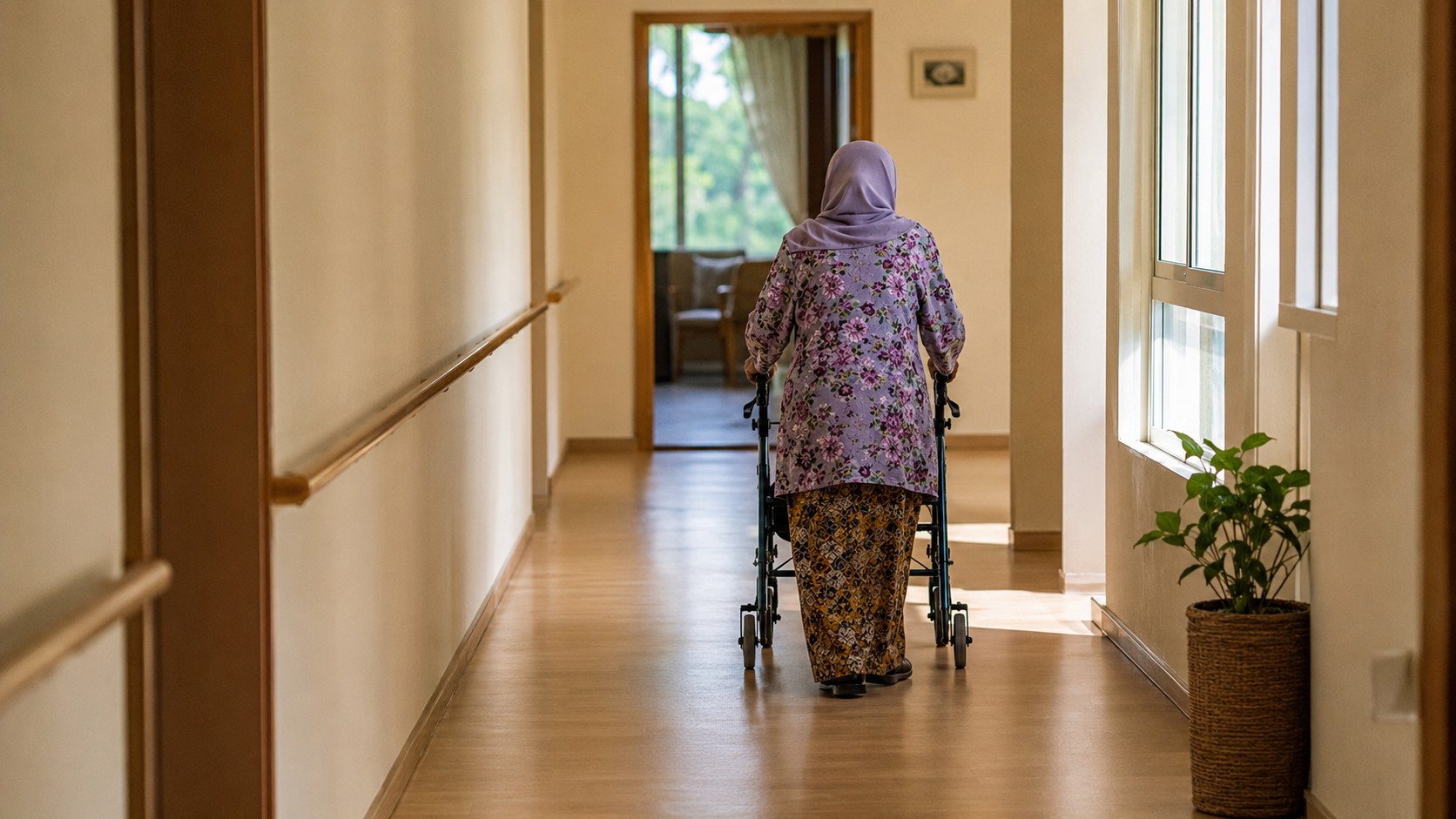
She moved into BIGTREE Medicare & Nursing Home shortly after. Within weeks, our clinical team had run bloodwork and urine tests, identified what had been missed, and drafted a referral for further investigation at hospital. She is eating full meals now. She walks the corridor every morning. She has put on weight.
I have been thinking about that woman since Deputy Prime Minister Datuk Seri Ahmad Zahid Hamidi instructed the Ministry of Women, Family and Community Development on 7 May to draft a Parents Care Act within six months. The proposed Act would impose legal responsibility on adult children to care for their elderly parents — with the DPM specifically citing concerns about families who place parents in care homes and fail to visit regularly.
The framing comes from a real concern. Cases of Malaysian families literally letting go — lepas tangan in Malay — have been rising for years. Between 2018 and mid-2022, more than 2,100 senior citizens were abandoned in hospitals nationwide. Hospital Kuala Lumpur alone reported a 50 percent jump from 239 cases in 2020 to 358 in 2023.
Abandonment is real. It is unconscionable. It must be addressed.
But the way the announcement was framed worries me, because it confuses two things that need to stay separate — and if the law confuses them too, it will punish the wrong families while doing little for the seniors who actually need help.
Placement is not abandonment
Let me say something almost nobody in the current policy debate is getting right.
Sending a parent to a licensed nursing home is not abandonment. Leaving a parent on a hospital bench is.
Most families who place a parent at a MOH-licensed nursing home are not abandoning anyone. They are sandwich-generation adults who have run out of viable alternatives. They have tried home care. They have tried rotating siblings. They have hired a maid who quit, or wasn’t trained for NG-tube feeding, or couldn’t lift a 70kg father onto a commode at 3am. By the time these families reach us, most have already spent months — sometimes years — trying to make home care work.
The decision to place a loved one in skilled nursing is not the moment caregiving fails. It is often the moment caregiving becomes medically appropriate. The families who actually fit the abandonment profile — the ones who drop off and disappear — are a small minority. Most visit weekly. Many visit daily. The DPM’s quote describes the problem as “sending them to old folks’ homes and leaving them without visits.” That is a real and shameful pattern. But the law as proposed risks treating placement itself as suspect — and that framing will land hardest on the families who are doing the right thing.
And what about the seniors with no children to compel?
This is what the story of the two sisters keeps reminding me of. A Parents Care Act, by definition, presumes there are children to hold accountable. But Malaysia has a growing population of older adults who never married, never had children, or whose children are overseas, estranged, or themselves unable to cope.
 These are the seniors most at risk of ending up in unregulated facilities, abandoned at hospitals, or — like the woman the sisters helped — surviving in places that call themselves care centres but cannot provide actual care. The previous facility wasn’t a bad place because the staff were cruel. It was a bad place for her because it wasn’t equipped to manage the medical complexity she needed managed. That is not a problem you fix by passing a law about adult children.
No filial duty law can reach these seniors. They need something else: a regulated, accessible, affordable system of professional eldercare. We don’t have that yet. Malaysia has 19 MOH-licensed nursing homes nationally and roughly 623 licensed beds — for a country approaching 4 million seniors. Until that gap is addressed, no law about adult children will solve the problem the DPM described.
Why this law has been 20 years in the making
The case for legislation is strong. Malaysia has been talking about a Parents Maintenance Bill since 2003. Singapore passed its Maintenance of Parents Act in 1995. Taiwan legislated in 1980. The Philippines in 2003. India in 2007. We are more than two decades behind our peers, and our elderly population will hit 14.5% of the total by 2040. We cannot keep promising a law and never delivering one.
But the international experience also offers warnings worth heeding. Singapore’s tribunal cases peaked at around 170 a year in its early period and have since fallen to roughly 30 a year — a sign the law worked, partly as deterrent and partly because most disputes were resolved through mediation before ever reaching court. Singapore also discovered, over nearly three decades of operation, that the law itself could be exploited by parents who had been the abusers. Those lessons took them 28 years to learn. A Malaysian Parents Care Act drafted in six months, without those lessons built in, would be a law primed for exploitation.
What a good Parents Care Act would look like
If I were invited by the Ministry of Women, Family and Community Development (KPWKM) — the ministry tasked with drafting this Act within six months — to share input from an operator who watches Malaysian families and friends navigate these decisions every week, I would offer five things.
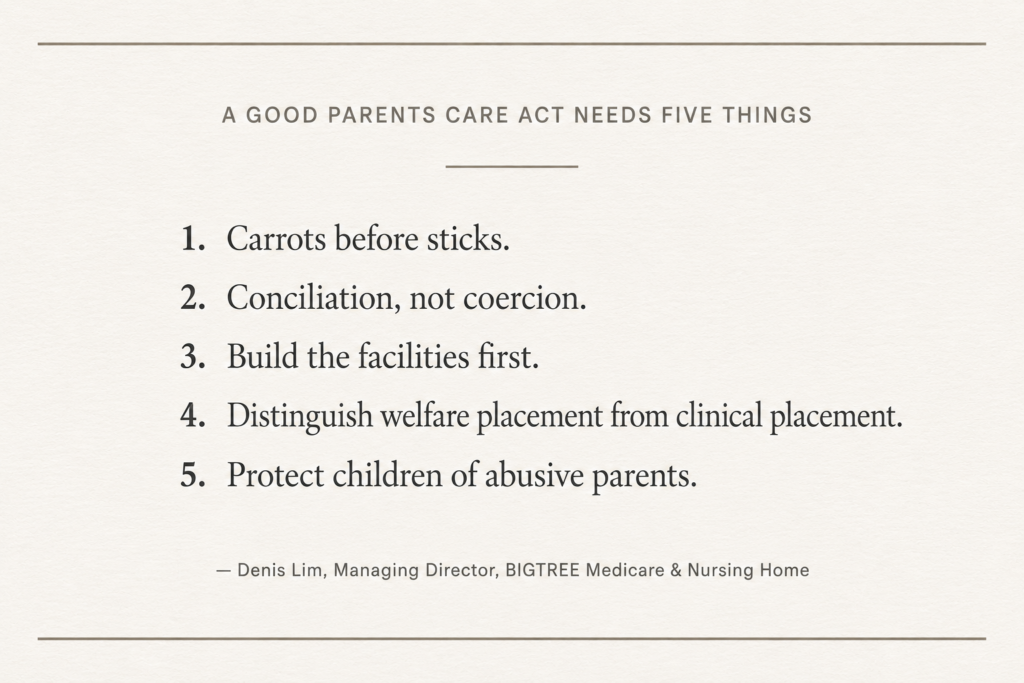
1. Carrots before sticks. Caregiver allowances. Tax reliefs that actually cover the cost of care. Pension credits for homemakers who never built EPF savings. Employer-supported caregiving leave. Build the support system before you legislate the obligation.
2. Conciliation, not coercion. Adopt Singapore’s compulsory mediation model. The Commissioner for the Maintenance of Parents resolves roughly 90 percent of cases before they ever reach the tribunal. Most filial conflicts are solvable when families are guided through the conversation by a trained third party — not when they are prosecuted.
3. Build the facilities first. Enforce PAHFAS, gazetted in 2018 and still sitting unenforced seven years later. Table the long-delayed Senior Citizens Bill. Fund serious expansion of MOH-licensed capacity. Until Malaysia has the infrastructure, criminalising care decisions is unjust.
4. Distinguish clearly between welfare placement and clinical placement. A nursing home is not an old folks’ home. One is a medical facility licensed under Act 586 to manage skilled nursing care; the other is a welfare facility registered under Act 506 for elderly companionship and basic support. The law must say so explicitly, because most Malaysian families still don’t know the difference — and that confusion is doing real harm to people who need clinical care and end up in welfare settings, or the reverse.
5. Protect children of abusive parents. Singapore introduced this protection in 2023, after nearly three decades of operation revealed that roughly a quarter to a third of maintenance cases involved parents who had themselves abandoned or abused their children. Malaysia can build this in from day one.
These five things, in this order, would make the difference between a law that protects elderly Malaysians and one that simply transfers blame.
The woman the sisters brought to us
 She came in unable to sit properly and needing a wheelchair to cross my office. She is walking now. She finishes her meals. The hospital referral our clinical team drafted will, with luck, get her the further investigation she needed months ago.
Two women with no legal duty to her did what a country’s eldercare system should have made unnecessary in the first place. They found her a place where she could be properly cared for, because the alternative was watching her fade in a facility that wasn’t equipped to help her.
That story is not what the Parents Care Act will fix. It is what a functioning eldercare system would have prevented. If the new law gets the distinction right — between abandonment and responsible placement, between facilities that can manage medical complexity and facilities that cannot — it will help. If it doesn’t, it will add legal weight to a guilt millions of Malaysian children already carry, while the seniors who have no children at all keep falling through the gaps.
Denis Lim is the Managing Director of BIGTREE Medicare & Nursing Home, one of Malaysia’s 19 MOH-licensed nursing homes and the second-largest by capacity. He is also Vice President of AgeCope Melaka. He writes about Malaysian eldercare policy and practice at bigtree.care.
Leave A Comment