
BIGTREE Medicare & Nursing Home
Not normal ageing: dementia in Malaysia is further along than the numbers say
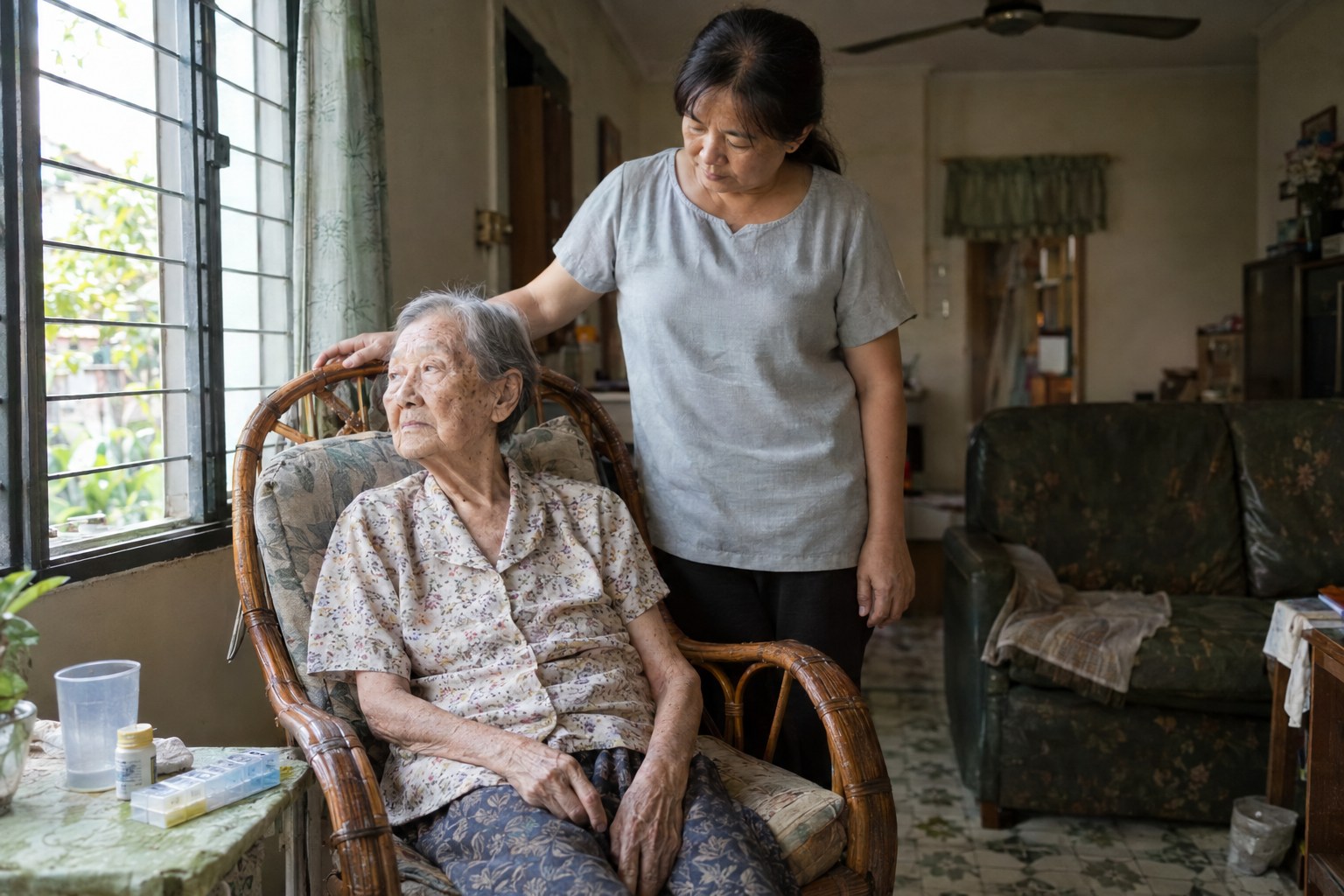
Close to half the people in our building are living with dementia. Nobody planned for that.
Nine days after we ran an Alzheimer’s screening in Melaka, the Ministry of Health released headline findings from the National Health and Morbidity Survey 2025. Dementia in Malaysia now affects 9.8 per cent of people aged 60 and above, up from 8.5 per cent in 2018. Roughly one in ten.
Walk our corridors and it’s closer to one in two.
I can’t give you a decimal point on that. No form collects it, and nobody asks. What I can tell you is what the building looks like, and close to half the people in it are living with dementia. And this isn’t a dementia facility. We take post-stroke, post-surgical, wound care and tube-feeding referrals.
That gap is the whole story.
Dementia is what ends home care.
Everything else on the referral form is what happened on the way. Families rarely call us about dementia. They call about the fall, or the discharge letter nobody at home can follow. Underneath is a disease that’s been running quietly for years under another name.
Malaysia’s MOH register, dated 17 July 2026, lists 18 licensed nursing homes and 629 beds between them. How many of those beds hold someone with dementia has never, as far as we can find, been asked. We hold 106 of them. No one designed it this way. Families ran out of road, and we were what was left.
Fifty places on a Saturday: an Alzheimer’s screening in Melaka
 The screening ran on Saturday 11 April in Taman Kota Laksamana. BIGTREE organised it with Healthy Malaysia Association and capped it at 50 places, open to anyone 50 and above, or 40 with risk factors. We paid for eight stations outright: hearing, retinal imaging, lung function, a vascular scan, a cognitive questionnaire, a doctor’s consultation among them. Participants paid RM380 for bloodwork, including a p-tau217 Alzheimer’s blood test normally priced around RM2,000.
Why pay for people who aren’t our residents? Because we only ever meet this disease at its far end. For once we wanted to be at the front of it.
Dr William Lee Wei Kiat, Consultant Physician and Geriatrician at Oriental Melaka Straits Medical Centre, gave the talk. His slides were in Chinese, with the key line in English too: 不是正常的老化. Not normal ageing. Memory goes, then judgement, and eventually a personality the family doesn’t recognise. A disease of the brain, he said. After 65, the risk roughly doubles every five years.
He surprised me by being straight about the test we’d just made affordable, limits and all. A positive result doesn’t guarantee you’ll develop the disease, and a result can cause needless anxiety. Diagnosis still needs a proper history, a neurological exam, cognitive testing, bloods for B12 and thyroid, sometimes a scan. Bloodwork opens that conversation. It can’t finish it.
I’d want every family to hear that before they hear the price.
The word Malaysian families use is “ageing”
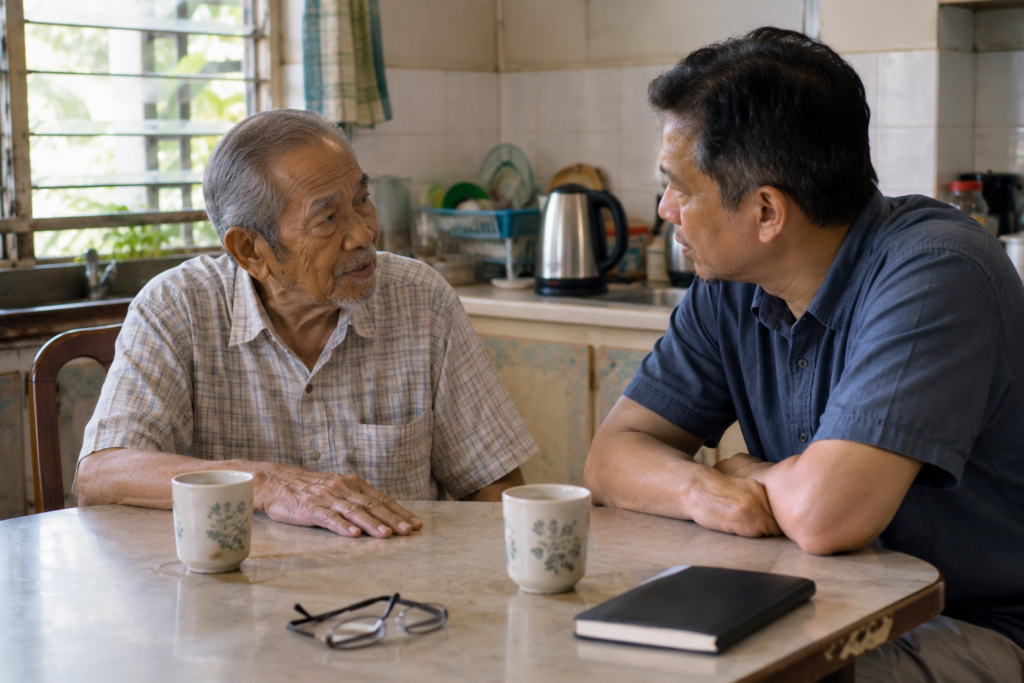 We’ve sat with more than 400 families since July 2024, and I’ve lost count of how many called years of decline “getting old”. The forgetting. The suspicion. The agitation after dark.
None of that was neglect. Malaysian families carry a parent for years, through 孝, through tanggungjawab, through plain love, and the carrying is what hides the disease. You don’t diagnose what you’ve learned to work around. Then someone gets hurt, or a spouse’s health breaks, and the disease has a decade’s head start.
The slides that stayed with me weren’t about drugs. They were about caregiver burnout, and about advance care planning, which means getting legal, financial and medical wishes written down while the person can still take part and sign something that holds. That’s what an early diagnosis buys. Not a cure. A window.
It costs almost nothing, and it almost never happens. Every week we sit with families deciding for a parent who could have told them himself.
Finding dementia early is half the job
Deputy Health Minister Datuk Hanifah Hajar Taib put it well when she launched the Dementia Care Champions Network. She said a dementia-ready Malaysia can’t be built through hospitals and clinics alone, but through informed families, trained caregivers, skilled care workers and supportive local communities. She’s right, and our Saturday in April was a small piece of it.
But finding it early only counts if what comes next is reachable. The country is learning to look ten years earlier, and what’s waiting at the end of those ten years is 629 licensed beds, almost none of them designed for dementia.
What a dementia-ready Malaysia would actually look like
Start with buildings this country doesn’t have. BIGTREE isn’t one. We’re built for clinical care, and it would be dishonest to call ourselves a dementia unit. A proper one would have outdoor space where someone can walk the same loop for an hour without meeting a locked door. Lighting for eyes that have lost depth perception, so a dark floor tile doesn’t read as a hole. More hands between midnight and dawn, when agitation peaks and rosters are thinnest. And a layout that doesn’t put the man recovering from hip surgery in the same corridor as the resident calling out at three in the morning.
We manage. Every operator manages. Both of those residents deserve better than a building doing its best.
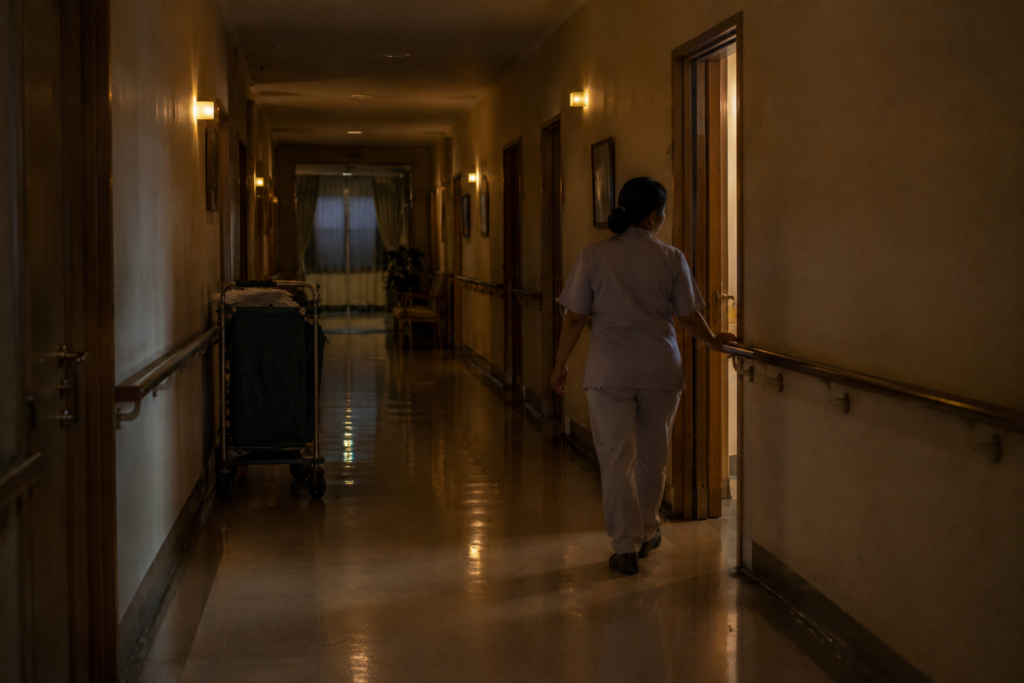 Then the people. Care workers qualify through SKM Level 3 in Elderly Care Centre Operation, JPK standard CC-013-3:2013. Its eight competency units run from receiving residents to end-of-life care. None of them is dementia. Level 4 is Administration and Level 5 is Management, so going further in this career means moving into an office. Our caregiver training with International Medical University has nowhere dementia-specific to lead. At the same launch, Datuk Hanifah said a care workforce needs clear career pathways. From where we sit, dementia is the one that’s missing.
National Care Standards for older persons are due in October, and we want them. Without a dementia competency behind them, though, they’ll describe care nobody’s been trained to give. Put dementia into the curriculum now, so the people are ready before the units open. And someone needs to count. You can’t plan beds for a population nobody has measured.
Dr William’s last slide read 记忆会褪色,但爱与尊严永远不应被遗忘. Memory fades, but love and dignity should never be forgotten.
I’d only add that dignity at the end of dementia needs a place to live, people trained to be there, and a price a family can manage.
If this sounds like your family
September is World Alzheimer’s Month. Don’t go looking for a bed yet. Stop calling it ageing, see a geriatrician, and have the conversation while your parent can still have it with you.
Denis Lim is Managing Director of BIGTREE Medicare & Nursing Home, one of 18 MOH-licensed nursing homes in Malaysia and the second largest by licensed capacity. He is Vice President of AgeCope Melaka and was selected by MITI as an Official Delegate to the Osaka Kansai World Expo 2025. National figures are from the MOH register of licensed private nursing homes, TARIKH KEMASKINI 17 July 2026. Dementia prevalence is from the National Health and Morbidity Survey 2025 findings released by the Ministry of Health on 20 April 2026.
Families in Melaka seeking a geriatric assessment can be referred to Dr William Lee Wei Kiat, Consultant Physician & Geriatrician, Oriental Melaka Straits Medical Centre (+606-225 2807).
The 11 April screening was organised by BIGTREE Medicare & Nursing Home with Healthy Malaysia Association (PPM-013-10-21102020) under research protocol NMRR-16-2391-33614.
Leave A Comment